Showing posts with label The Cocktail Hour. Show all posts

Tuesday, February 26, 2013

Portalicious


Port Tasting and Birthday Celebrations!

Up until our tasting last month, I hadn't a clue what port was really all about. I had used it in cooking a fair bit - two of my favorite recipes are a marinade for rack of lamb and a pear and port fruitcake - and had enjoyed a glass at the end of a meal once or twice a year. However, I had never really known the difference between a basic ruby and tawny, let alone the aged and vintages of both. My, what an eye-opener tasting event! Ruby and tawny are so very different - tawny being the amber adult cousin of the youthful, sweet, Ruby. Both are loveable, but you'll probably prefer one over the other.

In the picture above, you'll notice we tried basic versions of both as well as a 1994 vintage porto and a 10-year aged tawny. The latter two were sophisticated versions of their younger siblings. They were softer, richer in depth, and nuanced.

The main difference between ruby and tawny derives from the aging method. Ruby spends two to three years in stainless steel or wood before it is bottled, but tawny ages only in the cask and is at least three years old.  Indicated aged tawnies, such as our 10-year old above, are made from a blend of vintages with the average age being 10 years old - hence the label, same goes for the 20-year, 30-year and older tawny vintages - labeled age indicating the average vintage of the wine. You might also see Colheita, which we did not taste, but this is aged tawny from a single vintage. They range from 7 to 50 years aged in the cask. I wouldn't be averse to tasting of a Colheita one of these days.

The single vintage ruby, such as our 1994 Dow's, is the rarest and most expensive form of porto. The wine vintages must be declared by the company and approved by the authoritative body - the IVP (i.e., the Port Wine Institute - Instituto do Vinho do Porto). Unlike the tawnies that age in a cask, declared vintage rubies must be bottled between July 1 of the second year and June 30 of the third year after harvest. There are several other types of porto, but we hit a couple of highlights in our tasting.

Our tasting of these fine ports followed a fun birthday feast with fabulous friends. Tasting with friends is a rich experience with ample rewards of good conversation and much laughter - I highly recommend it.  Eric Asimov agrees with me - I just finished his book "How to Love Wine: A Memoir and Manifesto" in which he finds enjoying wine with friends is possibly the best way to taste wine.  I usually read his column in the New York Times so my husband gave me the book as a Christmas present (thanks, incredible husband of mine).  The book is a fun read and makes me feel better about our approach to wine, albeit Asimov wouldn't agree with the blind tasting we usually do. If you've ever felt inadequate about selecting or tasting wines, read his book - it will all make sense as to why you feel that way and how not to do so.

As a bonus at our tasting this time, one of our friends knew his port, which helped us all understand the beverage better than just reading about it in a book. He also kindly brought the upper-end bottles for us to experience!  Many thanks, Chris!

Sunday, November 4, 2012

Tasting Event #3


Thanksgiving is just around the corner, so we tasted four wines that should go well with turkey and fixin's. With help from our friends at Midtown Wine & Spirits, we picked out four very different wines - two whites and two reds:
  1. A German Riesling: Von Schleinitz from Mosel - Weissenberg Kabinett  @ $19.99
  2. A South African Chenin Blanc: Secateurs @ $16.99
  3. A California Pinot Noir: Belle Glos Meiomi @ $19.99
  4. A French Syrah-Grenache blend from the Languedoc region: H & B (Hecht & Bannier) Minervois @ $19.99
In order to determine which went best with thanksgiving food, we also served small plates of fall tastes - tenderized turkey breast steaks topped with stuffing and smothered in provolone with a splash of gravy, roasted sliced brussel sprouts with bacon, and a sweet and gold potato gratin.

So, our results: the Reisling was a little too sweet for most people on its own.  It was much better with the food, but some still thought it was too sweet. The Chenin Blanc was delicious on its own with a good minerality to it.  It had the acidity to cope with the richness of the food, yet it didn't really stand up well against the food. That is, it didn't bring anything to the food and its own flavors disappeared.  The Pinot Noir was the big hit, combining some nice up-front fruit with a bit of spice.  It was delicious by itself but paired extremely well with the food, especially the brussel sprouts. If you wanted something a little heartier than a Pinot Noir, the Minervois was exceptional. The Syrah-Grenache blend and style is similar to that of more widely available Cotes-du-Rhones, should you have trouble finding an offering from Minervois in your wine shop.

Happy Thanksgiving!

Saturday, October 13, 2012

Tasting Event #2


Sadly, my write-up from our last tasting is way overdue.  My apologies.  Sincere thanks go to Bradley at Midtown & Spirits for helping us pick out a great selection of five pinot noirs. Our second tasting consisted of pinots from New Zealand, France (Burgundy region), the Willamette Valley in Oregon and another from Russian River Valley, California. The last was an inexpensive, mass market, pinot noir from California.

Here are the details on the five:
  1. Mark West, California (mass market wine) - $10.99
  2. Nobilo Icon, New Zealand - $14.99
  3. Argyle, Willamette Valley, Oregon - $22.99
  4. LWC, Loring Wine Company, Russian River Valley, California - $19.99
  5. Marsannay, Louis Latour, the Burgundy region in France - $22.99
We paired the tastings with several cheeses, charcuterie and fresh ripe figs wrapped in prosciutto. While we did a blind tasting again, I was certain I knew which one I would like best. Imagine my surprise when what I thought would be my favorite turned out third on my list.  My first and second favorites were as much a surprise as was the group's consensus.  As happened last time, everyone liked all of them and would happily drink any of them (let's just say that no one in the group was sipping & spitting), but side-by-side (don't judge us too harshly) the Mark West, the least expensive, came in first.  Although it was neither a clear nor unanimous favorite (Nobilo & Argyle also got first-place votes), it was the definite winner as a value proposition. Our rank orderings diverged dramatically.  My second place was the New Zealand Pinot Noir.  What I had expected to by my favorite, the Argyle from Willamette Valley, came in as my third favorite. There was no consensus on the least favorite.

As for taste profiles, as reconstructed from sketchy notes and fading memory, the Mark West had a spiciness to it that stood out from the others and, perhaps surprisingly for a wine at that price point, clearly improved with time. The Marsannay had a bit of the earthiness that one associates with Burgundy, LWC had a floral nose and hints of strawberry, the Nobilo was black cherry, and the Argyle was silky smooth with hints of violet.

Next up...Turkey wines. What goes best with a Thanksgiving meal? Paired, of course, with a little turkey and other thanksgiving edibles.

Sunday, August 19, 2012

Tasting Event #1


We are playing with the notion of hosting a monthly tasting event. Having science backgrounds we find ourselves highly entertained by comparison tastings - does a Caipirinha taste better with 51 Cachaça or Pitú Cachaça?  Does a Manhattan taste better with 100% Rye or a blend of Rye and Bourbon? How do single malt Scotch Whiskys taste different by Scottish distillery and region?  Why stop with liquor, how about cheeses or chocolates?  And, better yet, why not share the fun with others? Yes, we have sciency friends, too, although that's not a prerequisite.

The warm weather of summer made us lean toward white wines as a first foray - crisp and cool would be welcome during this brutally hot summer. However, on second thought, we decided on Rosé wines. These delightful wines, best served between 10-12°C, provide an equally refreshing respite from the heat, and at our local wine shop we have noticed a growing selection each time we return. I was delighted to explore something that had been scorned in the US for many years (likely due to its association with White Zin), but now appears to have surged in popularity.

The difficult part in this entire plan was narrowing down which ones to taste. We ended up with nine guests for our first event and, while there is no rule in my book on how many wines one should taste at a tasting, we decided on four wines for this first foray. Once we knew how many we would taste, we then had to decide how to pick. Do we pick across countries (Chile, France, Spain, Italy, etc.) or, perhaps, within a country but across its regional variations? Because many different regions of France were represented among the offerings at our favorite local shop (Midtown Wine & Spirits), we decided to stay within France. We ended up with wines from the Loire Valley, the Rhone Valley, Provence, and the Savoie region (near the Alps). They were all 2011 vintages and cost between $14 and $20.  Here were the wines we served:
  1. Rosé Gamay from Les Rocailles (Appellation Vin De Savoie, near the Alps) at $15.99
  2. Rosé d'Anjou from Monmaousseau (Appellation Rosé d'Anjou, in the Loire valley) at $13.99
  3. Commanderie de la Bargemone (Appellation Coteaux d'Aix en Provence) at $18.99
  4. Chateau de Tringuevedel (Appellation Tavel, in the Rhone Valley) at $19.99
Now that wines were picked and guests had rsvp'd, we had to decide on nibbles to serve and the process of the event. We wanted the wines to speak for themselves so my husband opened the wines, removing all the foil, and put them into paper bags. Once he left the room, my job was to come in and number the bags randomly and then place them in order from 1 to 4. This allowed us to also participate in tasting without preconceived notions of what the wine would taste like (the Provence Rosé we served was one we drink often).

Each guest was given four wine glasses (renting glassware is easy and fairly cheap), some 3x5 note cards, oyster crackers and water for palate cleansing. Nosh was self-serve at their leisure. We provided cured meats, pecorino and idiazabal cheeses, olive tapanade, tomato bruschetta topping, and tomato-based spicy curry topping, along with sliced baguette and crackers.

At 4pm we all convened and proceeded to taste, compare and contrast. While I determined that I would drink any of the wines, we all had our favorites. I was alone in casting my vote for favorite to the Tavel, a wine that one guest said wanted to be a red wine. I prefer reds to anything else, so I guess I'm not surprised at my choice. The majority rated the Provence Rosé as the one they'd most likely buy. Provence is known as the Rosé region in France so our friends confirmed its reputation. This wine had the perfect balance of bright fruit flavors with a dry finish. The wine from the Savoie region was a little too understated for most, while the Rosé d'Anjou was on the sweet side for several of us. All except the Savoie received a vote for favorite, so we didn't end up with any skunks thanks to the help from our wine purveyor.

All in all I think we've hit upon a successful idea that we're excited to continue. For the next couple of weeks we get to ponder what will be next month's tasting!  Comment with your ideas and we'll let you know what we decide and how it turns out.

Sunday, July 1, 2012

An Experiment - #1 - Cucumber-Thyme Infused Vodka

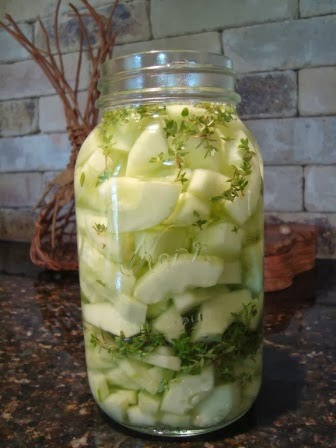
The CSA bundle this week, thanks to friends who have graciously donated their share to us while out-of-town, had oodles of cucumbers. What to make?  We recently revisited our frozen watermelon margaritas that includes grinding up cucumber as well as frozen watermelon chunks - the cucumber adds a layer of cool slightly savory flavor that rounds out the recipe - delicious!  This refreshing cocktail gave me a thought...infuse vodka with cucumber.  That sounds potentially interesting, but why stop there?  Maybe another layer of flavor is needed...perhaps thyme.  Who couldn't resist adding a herb that is growing heartily just a few steps from the kitchen door.  So, here starts the experiment.  I'll let you know in a few weeks how it turns out and what we make with it!


Saturday, March 17, 2012

Simple Appetizer


I recently had the wonderful opportunity to host my old book club while on a return visit to the city I moved from eight years ago.  It was wonderful to see everyone and have them all read my current favorite book, Stealing Mona Lisa.  Among the few nibbles I offered the favorite was cream cheese with Jezabel Sauce.  It's a very simple appetizer  that is sweet and salty with just the slightest hot kick.  They begged me to put it up on my blog.  Next time I'm going to put this sauce over goat cheese.

Jezabel  Sauce and Cheese Appetizer

Ingredients
  • 8 ounces regular cream cheese, tofutti, chèvre or goat cream cheese
  • 2/3 cup citrus marmalade (e.g., orange, mixed citrus, kumquat)
  • 2 Tablespoons horseradish sauce, or more to taste (use prepared sauce, not freshly grated)
Preparation

Bring all ingredients to room temperature.  Mix marmalade and horseradish together.  Spoon over cheese and serve with crackers.  If using a cream cheese, you can save a little back and put into a piping bag and decorate the rest of the block with rosettes before spooning over the sauce.  The decorating works best if serving a large crowd and using the big blocks of cream cheese (3 lbs.) you can purchase at Costco or a restaurant food supply store.  You then have more cream cheese to decorate with. It's a little skimpy to do this with the 8 ounce block, but doable if you double all the ingredients.

My mother makes a delicious kumquat marmalade that really sets this dish off, so if you have a kumquat tree, it's totally worth making marmalade out of the fruit and using it for this recipe!

Serve with crackers.

You can also serve the Jezabel sauce with meats such as ham, beef, or lamb.

Wednesday, December 28, 2011

New Year Nosh


I never seem to be able to stay awake until midnight on New Year's Eve, but I do enjoy New Year's Eve and New Year's Day nosh and drinks.  Here are a few easy things I'm going to make this year, followed by a few different drinks to try out.

Nosh
  1. Dried apricots with goat blue cheese - This is so easy, just slather each apricot with a little goat blue cheese, maybe add a marcona almond on top, and then drizzle with honey if so desired. I use the Blenheim variety of apricots (also known as "slab" apricots) available from Trader Joe's, but most any will do.
  2. Sundrops - Purchase a can of artichoke bottoms, rinse and drain.  Fill each bottom with crab meat and coat with hollandaise sauce.  Broil until lightly browned on top. Keep warm in the oven until ready to serve.  This also makes a great first course when you serve it on top of a little marinara sauce. The only key is to get high quality ingredients. These days it is hard to find good canned artichoke bottoms. The only one we can find here in the grocery stores is the "Reese" brand, and it is not very good.  If anyone knows of a good brand, please let me know!  Freshly cooked would be best, of course, but this time of year good, fresh artichokes are hard to get as well.
  3. Spinach balls with mustard sauce - these are so good, it's hard not to keep popping one after another into your mouth.
Ingredients
  • 10 ounces frozen spinach, thawed and squeezed of all its moisture
  • 1 1/2 cup prepared bread stuffing, cooled
  • 1 small onion, minced
  • 3 eggs
  • 1/3 cup melted butter
  • 1/4 cup grated parmessan cheese
  • 1/2 teaspoon garlic powder
  • 1/4 teaspoon freshly ground pepper
  • Mustard for serving (it's nice to have a variety - dijon, sweet, hot)
Preparation

Mix all ingredients together.  Roll into 1" balls and place on a baking sheet.  Bake at 350 degrees for 20 minutes.  Serve with mustard for dipping.

Drinkies

New Year's Eve drinks naturally revolve around champagne or prosecco. Bubbles are just the thing.  If champagne by itself doesn't do it for you, you might try these:

Korbel: http://www.korbel.com/New_Years_Cocktails.aspx

BakedBree Blog: http://bakedbree.com/cherry-thyme-champagne-cocktail

The other way to go with New Year's Eve cocktails in our house is the brown angle. Sazeracs, Manhattans, Rob Roys, and Old Fashioneds are just a few you can make in a batch and serve.

I'm inspired to try and make it to midnight this year! Wish me luck!

Saturday, December 3, 2011

The Catbird Seat Review

Oh my, oh my, oh my - if you live in Nashville, you finally have an opportunity to partake of an amazing tasting menu.  The Catbird Seat, from the owners of Patterson House, is a new small, 32-seat dining option. Although you might be hard pressed to get reservations within the month, it is an experience.  This isn't going out for dinner, this is truly something different, and we finally have it here in Nashville, with all the southern charm that makes the experience unique to living in the south. The owners, chefs and beverage manager are wonderful. They make delicious, remarkable food and they warmly welcome you and explain each course and matching beverage as they place them in front of you.

The food was great, and the paired drinks/wine were fascinating.  I highly, highly recommend you get the drink/wine pairing rather than just a bottle of wine. For some of the food/drink combinations I truly wondered how they figured out, out of all the beverages and combinations they could make, that that particular combination worked.  Given the unusual creations, they have a very astute and well-drunk (is that really a word that connotes the right message - I'm looking for the equivalent of "well-read") beverage manager.


Timing between the 9 courses was perfect. I was never wondering when the next course was coming and never felt it was there before I was ready. I was satiated when I left, but my runner husband was sad it was over and still wanting more.

Here is a picture catalog of each course:


The second taste was served with a cocktail that included Cocchi Americano, dry Reisling, and carbonated Rhum Agricole.


Served with a E. Dupont Cidre Bouche from Normandy France.  It was so earthy that it paired exceptionally well with the food, but I didn't care for it on its own. However, others at our table loved it both with and without food.


The optional fourth taste for those who wouldn't eat eggs - Octopus in its own ink sauce


The kimchi cod was probably my favorite taste.  Kimchi was pureed and dried into a ribbon wrapped around the cod, which was perfectly cooked.  If you read my post on Spanish food trends you will remember my disparaging comments about avocado with fish.  It just didn't work in the dishes we had in Spain, but the dab of avocado here perfectly off-set the spiciness of the kimchi.  This was served with a 2007 Robert Weil Reisling from Rheingau, Germany.

The duck was served with a 2009 Monfiore Gewurztraminer from the Willamette Valley, Oregon.


This was probably my second favorite taste.  The beef had reportedly been cooked for days.  It was incredibly tender, and the little piped dollop of truffle cream was amazing. This was served with a 2006 Domaine de Durban Beaumes-de-Venise, France.  We had visited this very winery last summer and loved their wines.


This was an explosion of flavor with curry, shitake, apricot and parsley in an eye-pleasing presentation.  Who doesn't love that bowl?  This was paired with a Belgian beer.


Another amazing presentation.  The drink on top was a blend of Lucky Bucket Certified Evil, Sherry and Madeira.  I could have been satiated here, but no there was more...

Here were flavors and textures that continued to melt in your mouth.  This was paired with a Royal Tokaji.  Then we finished up as we began - with oreos - this time sweet coffee and cream oreos.


Here is the menu they present us at the end.  Awesomeness!  If I haven't convinced you yet, I would be stunned...make your reservations now!  If you don't live in Nashville and plan to visit - make your reservations well ahead of time!

Thursday, June 16, 2011

My favorite summer cocktails – #3


Feeling like a beach vacation?  I know I am, but alas, that is a ways off.  So, maybe instead a quick weekend escape in a bottle? Ok, ok, not literally a weekend in a bottle, but a delicious drink from the beaches of Brazil is the Caipirinha and I find them mighty tasty on a hot summer day.  My husband introduced me to this delightfully lime-y, kick-you-in-the-pants drink after his trip to Recife, Brazil.

Ingredients
  • 1/2 lime cut into small pieces (can use a whole lime if small or you want it extra lime-y)
  • 1-2 teaspoons sugar (or whatever suits your palate--Brazilians use closer to a tablespoon)
  • 2 ounces Cachaça (common brands we find are Pitu and 51 - in a side-by-side taste test we found we preferred 51)
  • 1 - 4" sugar cane stick - optional (it's a fun effect if available, but otherwise a stirrer stick will do)
Preparation

Add the lime pieces and sugar to a rock glass.  With a muddler, mash the lime and sugar together, then pour in the cachaça and stir.  Fill rest of glass with ice, add sugar cane stick or stirrer (you'll want to stir the drink as the ice melts). Serves 1.

Now, drink slooowwwwly if at all possible to let that ice melt into the drink and imagine you are sitting on a hot Brazilian beach with the sparkling sea just within reach...

*A note about sugar: the Brazilian version my husband drank had dark raw sugar chunks and a lot more than 2 teaspoons of it, which meant you wanted to stir it often as the sugar started to dissolve.  I prefer my sugar to more fully dissolve so we use superfine sugar.  You could also substitute Splenda or 1/2 Splenda if you're cutting calories. The cachaça does not seem to mind.

Tuesday, May 17, 2011

My favorite summer cocktails - #1

Well, I couldn't let it go too long before sharing my favorite summer cocktails.  I have four.  I'll make you wait to find out what the other three are, but here is the first.

The Margarita - this is not just any old margarita, this is a humdinger.  If you like the taste of margaritas that come from pre-mixed packages this recipe is not for you.  This is also not for the hurried - you also need to leave yourself at least 6 hours to prepare it.

The original recipe came from Steven Raichlen's Barbecue Bible, although he took it from Rick Bayless' Frontera Grill (haven't been, but would love to go) in Chicago.  The original recipe said it served eight, but well, not really.  At least not in our house with our willingness to imbibe!  It makes eight drinks but serves more like four.

Ingredients
  • 1 3/4 cup tequila (we often use silver, but you can use any grade you prefer)
  • 1/4 cup orange liqueur (Triple Sec, Cointreau...)
  • 1 cup water
  • 1/3 cup sugar
  • 1/2 cup freshly-squeezed lime juice
  • 1+ teaspoon freshly and finely grated lime zest
  • 1/4 cup coarse sea salt
  • 8 lime wedges for garnish
  • 3-4 cups ice cubes for serving
Preparation

In the morning on the day that you plan to serve the margaritas, combine the tequila, orange liqueur, water, lime juice and zest, and sugar in a pitcher. Stir to dissolve the sugar, then let the mixture steep in the refrigerator, covered, for 6 to 8 hours. Don't be tempted to skimp on the time.

Spread the salt in a shallow dish. Rub the rims of 4-8 margarita or martini glasses with the cut side of a lime and dip each glass rim in the salt, shaking off the excess. Add the ice to glasses and then strain the sublime margarita mixture into the glasses. Drop a lime wedge in each glass and serve immediately.

The glass prep is pretty obvious, but I've included it for completeness—just don’t forget to strain the lime zest out. We tend to serve over ice in the glass rather than straight up or blended. We've never tried blenderizing, so if you try that let me know how it turns out!  The key elements are the lime zest and the steeping time.